Ownership
- UX/product risk framing
- Prioritization criteria
- Experience direction
- Stakeholder alignment
- Decision ownership documentation
Kimberly-Clark, Consumer Goods
Reframed UX from opinion into quantified business risk, reshaping a locked launch and establishing the product operating model the organization lacked.
Core challenge
How do you deliver a 0-1 digital product when decision authority is unclear, engineering has already committed to timelines, and the organization has no muscle for iterative development?
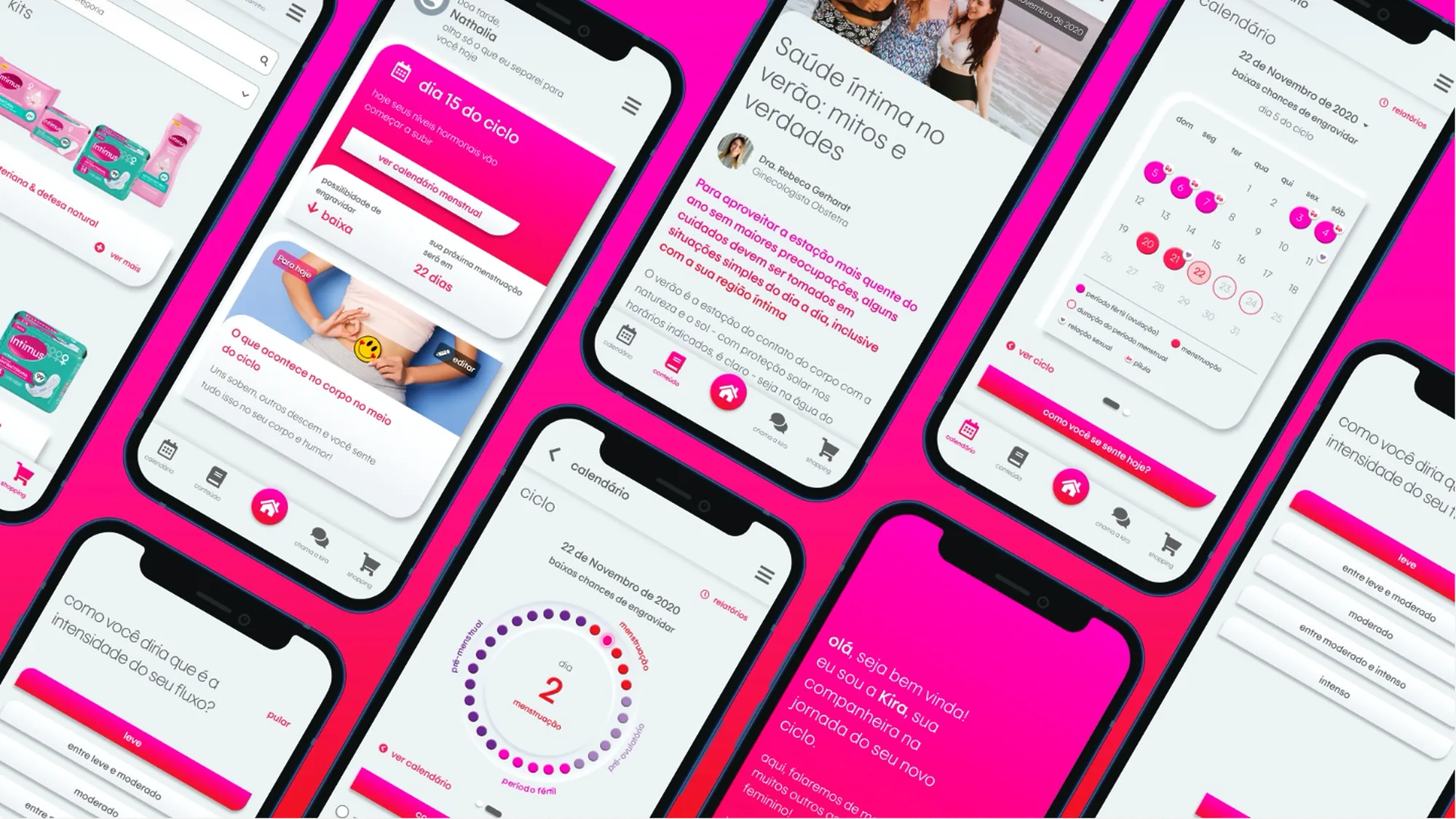
The opportunity was to capture 1M+ first-party data leads from a 15-24 year-old female target through a period tracker and D2C commerce platform. This was K-C's first consumer-facing digital product with product KPIs (NPS, CSAT, stickiness, retention) instead of traditional marketing campaign metrics.
Engineering timelines and cost estimates were committed before UX was involved. Design entered a process where scope, deadlines, and technical constraints were already locked. No digital product operating model existed: the organization shipped campaigns, not products. Three vendors had misaligned incentives and no single owner.
Owned experience direction, risk framing, and prioritization without formal product authority.
Preliminary usability tests revealed critical onboarding issues after engineering had committed to the launch date. I documented risk to user acquisition, not just 'bad UX', and surfaced decision ownership explicitly: engineering owns timeline, UX owns conversion risk, we need exec alignment. This secured a limited iteration window for the highest-impact fixes.
Multiple stakeholders pushed conflicting features with no prioritization framework. I created decision criteria around first-party data acquisition impact versus development complexity, then forced an explicit tradeoff discussion: are we optimizing for D1 acquisition or D30 retention? The team aligned on a phased launch: core tracker and content platform first, commerce post-launch.
Engineering expected full spec upfront. I introduced prototyping and early validation before full development, framing the change as risk reduction to make it legible to engineering and business stakeholders. This established a continuous learning model that became standard for subsequent projects.
Design entered a process where scope, deadlines, and technical constraints were already locked.
No precedent for iterative development. No shared language for product KPIs. No decision framework for feature tradeoffs.
I made UX legible as risk to acquisition KPIs, not taste, and created change through demonstration rather than mandate.
Risk documentation, prioritization criteria, and phased launch scope.
9% penetration in 15-24 target market through period tracker and D2C platform
First K-C digital product tracked with product KPIs instead of campaign metrics
Iterative development and decision surfacing practices scaled from LATAM to global
Multi-vendor coordination across Ogilvy, Accenture, and internal business stakeholders.
Operated as de facto product and experience lead for LATAM delivery, coordinating Ogilvy (creative agency), Accenture (offshore engineering), and internal business stakeholders. No formal product authority. Coordination happened by surfacing decisions early, documenting risk procedurally, and translating UX concerns into business and engineering language.
This role became the foundation for promotion to Global UX Strategy Lead in 18 months. The multi-vendor coordination model, iterative development workflows, and decision surfacing approach applied directly to the global transformation.